






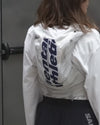




Our New Balance special cover story, starring Tom McGrath, is shot by Alain Levitt, the photographer who spent the early 2000s documenting downtown New York from the inside. Alongside it, he talks with Daria Miricola about the small-town feel of post-9/11 Manhattan, a gallery opening that ended in complete mayhem, the photo album that became an archive, and why he's happier now than he's ever been.
ALAIN LEVITT
INTERVIEW BY DARIA MIRICOLA


Daria Miricola:
When you were starting out, which styles and figures were defining the American photography scene? And who inspired you personally, inside and outside that scene?formed. It took me another twenty years or so to figure out my own.
Alain Levitt:
My sister, Danielle Levitt, was the biggest influence on my becoming a photographer. By the late '90s she was working, even though she hadn't broken through yet, and I was paying close attention. Another huge influence was Terry Richardson. While I was still living in Los Angeles, I saw him on a TV show shooting a major job with a point-and-shoot camera. I've never had a strong grasp of the technical side of things, so watching him work made photography feel accessible, like I could do it too. Then, when I moved to New York, Ryan McGinley became a big inspiration. He was younger than me but much more sure of himself as an artist; his vision already seemed fully formed. It took me another twenty years or so to figure out my own.


DM:
Underground and celebrity culture were bleeding into each other. What do you think made your slice of New York so magnetic to more exclusive industries like fashion, film, music?
WH:
In the early 2000s, New York felt like a small town. Williamsburg's influence was just beginning to take hold, but people could still afford to live in Manhattan, and everyone I knew lived downtown. At least 90 percent of my images were taken below Fourteenth Street. It definitely wasn't the Lower East Side of the '70s and '80s, but it was still very much a neighborhood with history and roots, and wherever we spent the most time, Tompkins Square Park, Max Fish, Alife, Autumn Skateshop, became the backdrop. Manhattan had more of a Sex and the City feel at that moment, and I think we wanted something dirtier. Vice was definitely egging on our bad behavior. Then 9/11 happened, and it gave us a "fuck it" sort of attitude. There was this mix of proximity, ambition, and recklessness. Everyone was close enough to everyone else that things felt possible, and the spotlight was there, making our delusions seem attainable. I think that energy drew people in. It was a beautiful moment.


DM:
Was there any real contact with the fine art world? Were galleries and museums part of your orbit, and if so, which galleries and which artists felt closest to your world?
AL:
Ryan McGinley was the first person I knew to be fully embraced by the art world. It's hard to describe what a big deal his Whitney show was, not to mention those pictures ended up introducing the world to Dash Snow, Kunle Martins, Dan Colen, Nate Lowman, and others. I could be wrong, but I believe Rivington Arms, Mirabelle Marden and Melissa Bent's gallery, was the first to officially represent people from this group and gave some of them their first shows. The Street Market show at Deitch, with Espo, Twist, Reas, and others, was also so major. It ended in complete mayhem, the classic "this is why you can't have anything nice" sort of moment. I give Jeffrey Deitch a lot of respect for not turning his back on the scene after that opening. It was 100 percent the most fun night of my entire time in New York.


DM:
Do you have muses? Are they people you naturally keep coming back to, or people you can never quite capture, because something always slips away?
AL:
There's always someone I'm watching a little more closely, someone who gives me a little extra and makes things happen just by being themselves. I suppose that's my version of a muse. I don't really plan pictures or try to force a moment. I wait for something to happen and try to capture it, and certain people, with their charm, magnetism, or quirkiness, just make that easier. Funnily enough, the opposite is true for people who don't like having their picture taken: no matter what you try, every photo has a look of almost painful discomfort. However badly I want the shot, I tend to back off at that point. If I get the feeling I'm making you uncomfortable, it's just not worth it.
DM:
You've spoken about feeling weird, even invisible, back then. Was that just you, or was everyone feeling the same, only hiding it better? Was there a collective fragility under all that freedom?
AL:
It might not have been just me. We were all damaged. I've always felt uneasy socially and used photography as a stand-in for connection, but I don't remember ever talking to anyone about it; I was always in my own head. We had fun and acted out, and the recklessness always ramped up when something was bothering you. On some level we understood each other, and as long as you hadn't gone too far, you were forgiven the next day.


DM:
You often pair your photographs with first-person writing, where words, memory, and nostalgia all play their part. That intimate, diary-like voice ran through a whole era of magazines like Vice. Where do you think it came from, and what has it passed on to Instagram today?
AL:
The photos are my memories. If there isn't a picture, chances are I've forgotten it happened. Maybe that's why I romanticize those moments and speak of them with such reverence. At its heart, my work from that era is a photo album. It was never intended to be art. It's people I love, in a time that means even more to me now than it did then. It's deeply personal, and I hope the people in the pictures feel that too and speak of their own memories with the same affection. When I first started sharing my archive on Instagram, during COVID, the audience was mostly people who'd been there, and a trip down memory lane felt better than worrying about the future. What I didn't realize was how much the pictures would resonate with a younger audience, who look at them in their own way—maybe longing for a freedom and recklessness they feel they never had. Kids today have to think about everything, knowing every mistake could be documented forever. We made mistakes, and most were forgotten. Still, things my kids say make me think their generation is already pushing back, in quirky, sometimes even more subversive ways: less obvious, but still authentic.


DM:
Looking at your photographs from back then and the ones you take now, what do you think has changed in the way you see, and what has stayed the same?
AL:
My approach is still the same: I take pictures of people I love. What's changed with age is how I see my work. I'm no longer comparing myself to other people or feeling devastated by what I see as failures. I don't feel like I have to prove anything anymore; what I do is enough. That takes a lot of the pressure off. I guess I'm making work from a place of happiness now, rather than insecurity, and maybe that allows more joy to come through in the pictures. I'm only thinking about this now for the first time. Who knows?
DM:
Of all the moments you've captured, is there one you'd go back and live again?
AL:
No way! I'm so much happier now. We had so much fun, but boy, was everything complicated—usually because of me. I'm looking forward to what I get to shoot tomorrow!